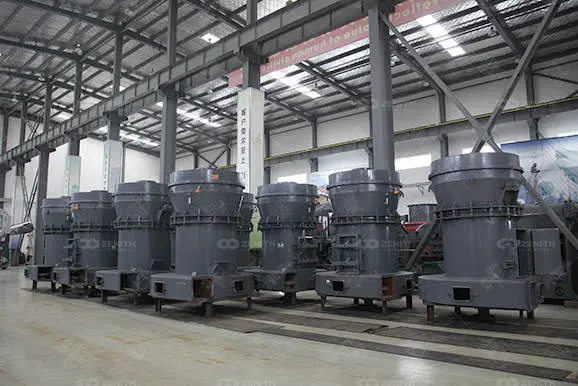
Ball mills are critical equipment in the mining and mineral processing industries, used for grinding materials into fine powders. The rotational speed, or RPM (revolutions per minute), is a crucial factor that influences the efficiency and effectiveness of the milling process. This article explores how to determine the optimal RPM for a ball mill with a 45-inch diameter.
Before calculating the optimal RPM, it’s important to understand the mechanics of a ball mill:
– Shell: The cylindrical body of the mill.
– Balls: Grinding media that crush and grind the material.
– Motor: Powers the rotation of the mill.
– Material is fed into the mill.
– Balls impact and grind the material.
– The rotation speed influences the grinding efficiency.
Several factors must be considered when determining the RPM for a ball mill:
The critical speed of a ball mill can be calculated using the following formula:
\[ \text{Critical Speed (C)} = \frac{76.6}{\sqrt{D}} \]
Where:
For a 45-inch diameter mill:
\[ C = \frac{76.6}{\sqrt{3.75}} \approx 39.5 \, \text{RPM} \]
Typically, ball mills operate at 65% to 75% of the critical speed to ensure efficient grinding and avoid excessive wear. Therefore, for a 45-inch diameter mill:
– Minimum: \( 0.65 \times 39.5 \approx 25.7 \, \text{RPM} \)
– Maximum: \( 0.75 \times 39.5 \approx 29.6 \, \text{RPM} \)
When setting the RPM for a ball mill, consider the following practical aspects:
Determining the optimal RPM for a ball mill involves understanding the critical speed and adjusting for practical considerations. For a 45-inch diameter mill, operating between 25.7 RPM and 29.6 RPM is recommended to balance efficiency and wear. Always consider the specific material and desired outcome when setting the RPM to ensure optimal performance.