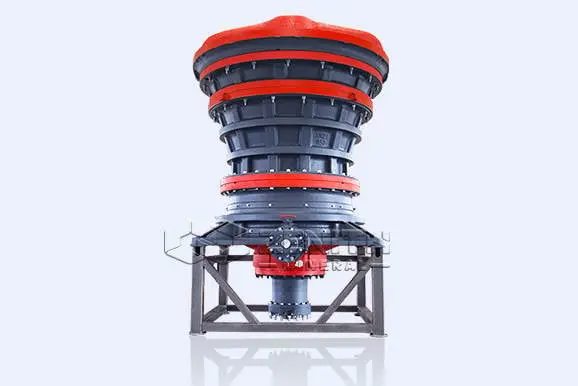
Cone crushers are essential equipment in the mining and aggregate industries, used for crushing various types of rocks and ores. They come in different configurations, notably the standard and shorthead types. Understanding the differences between these two types is crucial for selecting the right equipment for specific applications.
Cone crushers operate by compressing the feed material between a moving piece of steel and a stationary piece. The material is crushed into smaller sizes and discharged through the bottom. They are widely used due to their efficiency and ability to produce a uniform particle size.
The standard cone crusher is designed for secondary crushing applications. It is typically used when the material is not too abrasive and requires a medium to coarse product size.
The shorthead cone crusher is used for tertiary or quaternary crushing, where finer products are required. It is designed to produce smaller, more precise particle sizes.
– Standard: Larger feed opening for larger material sizes.
– Shorthead: Smaller feed opening for finer material sizes.
– Standard: Longer chamber for gradual reduction.
– Shorthead: Shorter chamber for steeper reduction.
– Standard: Lower force, suitable for softer materials.
– Shorthead: Higher force, suitable for harder materials.
– Standard: Produces medium to coarse aggregates.
– Shorthead: Produces fine aggregates and sand.
– Standard: Best for less abrasive materials.
– Shorthead: Best for more abrasive materials needing finer reduction.
Choosing between a standard and shorthead cone crusher depends on the specific needs of the operation. The standard cone crusher is ideal for secondary crushing with medium to coarse products, while the shorthead cone crusher excels in tertiary and quaternary applications, producing finer aggregates. Understanding these differences ensures optimal equipment selection and efficient processing in mining and aggregate production.